
How low-yield or fallow vineyards can be used for solar power generation.
Less wine, more sunshine

In Brackenheim, in the Heilbronn district, hep global GmbH is planning a new solar project on land previously used for vineyards. Starting in 2028, a solar park with a capacity of 7.4 megawatts peak is set to be built on approximately five hectares. In the future, the site could generate around seven million kilowatt-hours of solar power per year—enough to supply about 2,000 average households with electricity.
Viticulture Under Economic Pressure
Declining wine consumption, growing international competition, and structural challenges have been weighing on German viticulture for years. In Baden-Württemberg and Rhineland-Palatinate in particular, demand for traditionally produced, rather full-bodied red wines is falling.
Added to this are rising costs in cultivation itself. Steep-slope viticulture, i.e., cultivation on slopes with a gradient of more than 30%, is considered particularly labor-intensive. According to data from the German Wine Institute (DWI), easily mechanized flat areas require around 200 labor hours per hectare, while steep slopes can require up to 1,000 labor hours annually.
Not every region and every area is affected to the same extent. However, vineyards with high operating costs and unresolved succession issues are coming under increasing economic pressure.
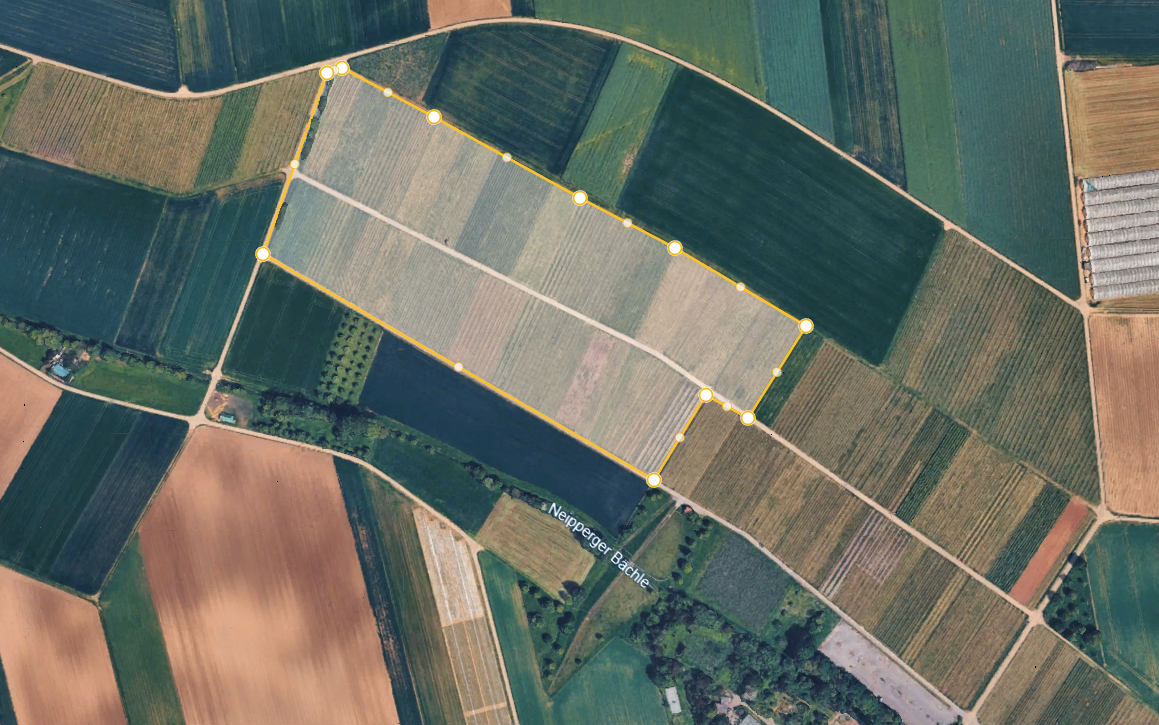
A bird’s-eye view: the Brackenheim solar park is planned for the marked area.
Alternatives for Unprofitable Vineyard Land
The area between Dürrenzimmern and Hausen is currently still used for viticulture, but is considered low-yielding due to its sloping terrain and high susceptibility to frost—particularly late frosts. At the same time, the soil is only of limited suitability for alternative agricultural uses. While fruit growing or certain specialty crops remain possible in principle, traditional arable farming on such land is often considered uneconomical.
For photovoltaics, however, the area offers good conditions. Solar modules can be flexibly installed even on topographically challenging and comparatively small parcels of land.
“Not every vineyard is uneconomical and should be hastily repurposed,” says Alexander Hügler, the contact person for land acquisition at hep global. “For affected operations, however, photovoltaics can be a sensible addition. The sites generate regular and predictable income with comparatively low management costs and can thus have an economically stabilizing effect.”
Removable rather than permanently sealed
Solar power production does not permanently seal an area but merely covers it. This ensures it remains reversibly usable in the long term. Should viticulture become significantly more attractive again in 20 or 30 years, solar systems can be dismantled with virtually no residue, and the land can be used for viticulture once more.
At the same time, sensible repurposing prevents vineyards from lying fallow. This is because unused vineyard land can facilitate the spread of pests and infectious diseases, thereby infesting adjacent growing areas.
The combination of viticulture and photovoltaics: Viti-PV
In addition to completely repurposing a vineyard, it is also possible to combine viticulture with energy production. In so-called Viti-PV, solar modules are installed directly above the grapevines to protect them, delay grape ripening, and reduce harvest losses.
Whether a vineyard is suitable for Viti-PV, however, depends on many factors that owners should review individually with experts. For instance, building code regulations must be complied with, shading must not impair wine quality, and self-consumption or electricity off-take must be ensured.
Focus on Regional Electricity Supply
For the Brackenheim solar project, the solar power generated is to be sold in the future to companies in the region via long-term power purchase agreements (PPAs).
The municipality has already issued the installation permit for the project. At the same time, initial environmental impact assessments have been commissioned to examine, among other things, local bird and reptile populations in order to plan necessary mitigation measures at an early stage.
Through this project, hep global is linking the energy transition with regional land use—not as opposing concepts, but as a potential response to changing economic conditions in the wine industry.
Sources: hep solar, Warum sich der Weinbau in einem Strukturwandel befindet | FAZ, Weinerzeugung 2025: Rückgang um 2,6% auf 7,55 Millionen Hektoliter – Statistisches Bundesamt, Weinbau: Rechtecke ohne Reben – Weinkrise mit mehr Weinbergsbrachen? | STERN.de, Statistik_2025.indd, Rückläufige Weineinkäufe | der deutsche weinbau, Allgemeine Infos: Ministerium für Ländlichen Raum, Landwirtschaft und Heimat Baden-Württemberg, Viti-PV – Nachhaltiger Wein in Baden-Württemberg