A solar park by hep solar
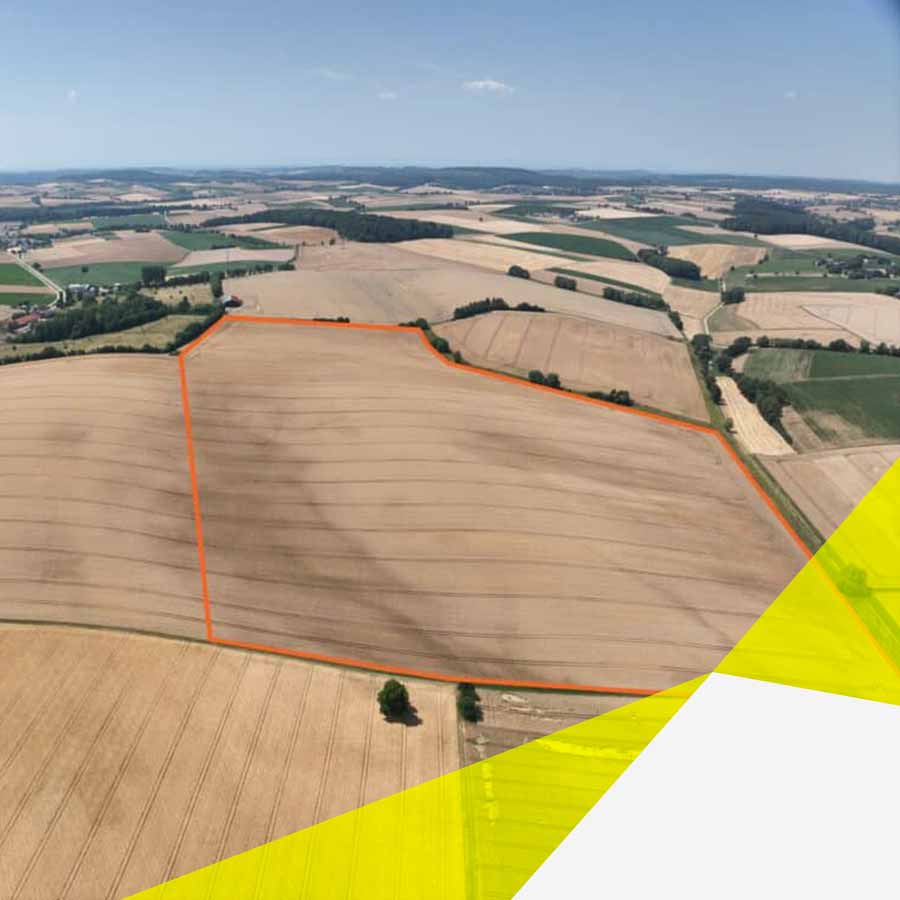
Buckeläcker Solar Park
Technical Details: Buckeläcker Solar Park
| Key Facts | |
|---|---|
| Solar Panel Area | 30 acres |
| Capacity | 35.7 MWp |
| Specific Yield | 38 GWh/year |
| Households Supplied | Ø 10,800/year |
| Emissions Avoided | 14,595 t/year |
| Expected Lifetime | 30 years |
Planning Phase
A solar park project begins with a comprehensive conceptualization and analysis phase. Teams of experts evaluate potential sites for suitability, taking into account factors such as solar irradiance, access to the power grid, environmental requirements, and technical feasibility. At the same time, initial plant designs, economic feasibility calculations, and feasibility studies are developed. Additionally, consultations with landowners take place, and the optimal route for the power lines to the grid connection point is determined. The goal of this phase is to develop a robust, sustainable, and economically viable overall concept.
Approval Phase
Once the project concept has been finalized, the formal approval process begins. Project managers submit all necessary documentation—including, for example, applications for building and environmental permits, as well as for grid connection. Environmental or species protection assessments are often prepared as part of this process. Depending on site conditions and the scale of the project, this phase can vary significantly and take anywhere from several months to several years.
Construction
Once all permits have been obtained, construction begins. The site is first prepared before the mounting structures, solar modules, and inverters are installed. At the same time, the internal and external cabling is installed and the connection to the public grid is established. The construction period depends on the size of the system but typically ranges from a few weeks to several months. Finally, a detailed technical inspection is conducted to ensure safe and reliable operation.
Operation
Once all functional and safety tests have been completed, the solar park begins regular operation. From this point on, the plant continuously feeds climate-friendly electricity into the grid. With the final technical acceptance, long-term operation begins, which is typically designed to last for many decades. This generates renewable energy on a permanent basis, contributing to a sustainable electricity supply.
Frequently Asked Questions
Buckeläcker Solar Park Biodiversity
Solar farms can serve as a refuge for native species. Since the area is mowed no more than twice a year, the site offers birds, insects, and small mammals the opportunity to settle there. The fencing is permeable to small mammals, allowing them access to the site. With sufficient clearance above the ground and row spacing of at least two meters, the ground continues to receive enough sunlight and precipitation for a diverse flora and fauna to thrive. Additional species conservation measures for protected species are implemented in and around the site and regularly reviewed by experts.
Integration of the solar farm
The facilities occupy large areas. To minimize their impact on the surrounding area, hedges are planned to reduce the visibility of the facility and the fence.
Surroundings of the Buckeläcker Solar Park
Before the facility is built, potential glare from the solar modules on nearby roads and buildings is assessed. To prevent glare, specially coated PV modules are used or gaps are left in the appropriate locations. This ensures that there is no significant glare in the surrounding area.
Maintenance of the Buckeläcker Solar Park
The solar field will be planted using native seed mixtures. We plan to use sheep to graze the area and are already in contact with local shepherds for this purpose. Alternatively, the area will be mowed by machine no more than twice a year at times that are appropriate for species conservation.
End of Operational Lifespan
The system has a limited operational lifespan (typically 30 years). After that, there are two options: the PV system can either be dismantled or refurbished and kept in operation. Even after a long period of operation, the components still maintain high performance levels, so continued operation or refurbishment is, in principle, possible. There are no costs to the owners or municipalities.
Community and Residents
A project company in the form of a GmbH & Co. KG will be established to operate the solar park; it will be headquartered in Eppingen. As a result, the trade tax generated will benefit the local municipality. Investors have the option of participating in the solar projects through hep solar financial products.

How does a solar farm work?
And why are more and more regions turning to our expertise?
Have you ever wondered how sunlight is transformed into clean electricity for thousands of households? A solar farm is much more than just an area covered with solar panels—it is a state-of-the-art power plant that efficiently and reliably feeds renewable energy into the grid.