
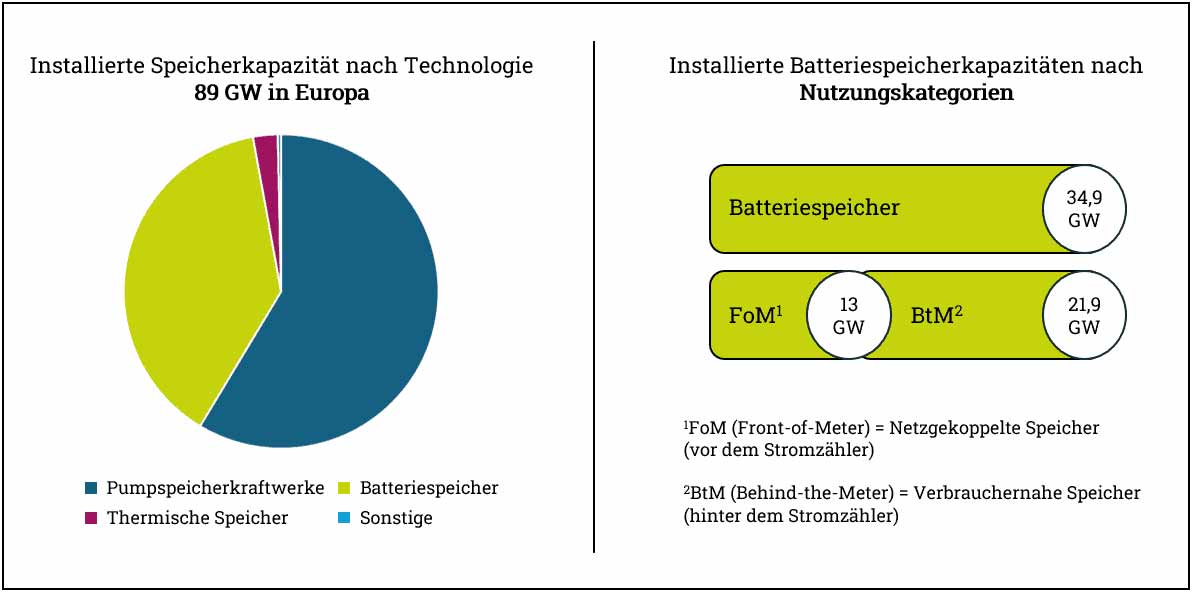
Hardly any other topic is currently generating as much excitement in the energy sector as battery storage—and for good reason: its importance for a stable, climate-neutral energy system is growing. By the end of 2024, approximately 11.8 gigawatts of battery storage had been installed in Germany, and about 34.9 gigawatts across Europe. The majority of this capacity consists of home storage systems operated directly in private households. But the real leverage lies elsewhere: in large-scale grid-connected storage systems. Countries like Australia, the U.S., and the U.K. are leading the way: there, these systems are already an integral part of the power grid. In Japan, too, the market is being actively developed, and solar specialists such as hep solar and Toshiba Energy Systems & Solutions are working together to implement relevant projects. But what do these storage systems actually do? What are the technical and economic factors behind the growing interest—and where are their limits?
Energy Storage – The Key to Modern Energy Supply?

What are energy storage systems—and how do they work?
Energy storage systems make electricity available on a time-delayed basis: they store energy when more is produced than is consumed, and release it again as soon as demand rises. Battery storage systems based on lithium-ion cells currently dominate the market. They store electricity through electrochemical processes in which lithium ions move back and forth between two electrodes. This method offers high efficiency of up to 90%, meaning that only a small portion of the energy is lost during storage and discharge.
In practice, they are most commonly used as large-scale modular storage systems—industrially operated container facilities consisting of hundreds of battery modules. So-called hybrid solutions are also becoming increasingly common: storage systems operated at the same site as a photovoltaic system. This reduces construction and grid connection costs—and enables the generated electricity to be fed into the grid in a coordinated manner. Other storage technologies, such as pumped-storage power plants or hydrogen systems, play a role primarily in seasonal long-term storage. So far, they have been less suitable for short-term power shifts—such as those occurring throughout the day.
Why We Need Energy Storage
With every new wind turbine and every additional solar power system, the need for storage solutions grows. This is because electricity from renewable sources isn’t generated when it’s needed—but rather when the sun is shining and the wind is blowing. Especially at midday, when solar systems are running at full capacity, there is often a surplus of electricity. At that point, the market price drops rapidly—at times even falling into negative territory. In such moments, grid overloads become a risk, systems are curtailed—and emission-free electricity is lost unused.
In the evening, however, when demand rises, solar systems no longer generate electricity. Without storage, we must then rely on conventional energy sources. This is inefficient and represents a missed opportunity for climate protection. This is exactly where battery storage comes into play: it captures the surplus energy generated at midday and releases it as needed in the evening hours or during grid bottlenecks. In this way, they make renewable energy controllable, stabilize the grid, and reduce dependence on fossil fuel reserves.
Energy Storage in Practice: Between Potential and Limitations
Energy storage systems play an essential role in integrating renewable energy into the power grid. Yet despite all their advantages, challenges remain. Storage systems are still expensive to purchase—and their operating models are often complex. It is impossible to predict in general terms when energy storage projects will pay for themselves. This is because they generate revenue through arbitrage—that is, buying electricity when prices are low and selling it when prices are high. But this market-driven approach is not always in the best interest of the power grid. From the grid’s perspective, it would often be more helpful to operate storage systems specifically where grids are weak or unstable—even if that is less economically attractive. It is precisely this conflict of objectives between market and grid logic that currently presents the industry with a central dilemma. Furthermore, if too many storage facilities respond to the same price signals, it can lead to a cannibalization of revenues. If, for example, everyone feeds into the grid at the same time, the exchange price drops—and with it, profits.
Looking ahead: new solutions, new opportunities
Nevertheless, progress is being made, and many of the outstanding issues can be resolved in the long term. While technological innovations are making storage systems increasingly efficient, new compensation models are reducing planning and market price risks for project developers and investors. Two terms are gaining importance in this context: Capacity Purchase Agreement (CPA) and Power Purchase Agreement (PPA), specifically for storage systems.
- CPA: Also known as “tolling,” this refers to a fixed, guaranteed payment per megawatt of installed capacity. Under this arrangement, the capacity of a storage facility is made available to a third party, which decides how to use the resources and handles the marketing.
• PPA: A long-term power purchase agreement under which the stored electricity, which is later fed into the grid, is marketed under agreed terms—such as a fixed price or an index-based pricing formula. This model is already widely used in the photovoltaic sector.
Conclusion: The hype surrounding energy storage is justified—as long as it is viewed in the right context. It is not a panacea, but an indispensable building block on the path to a stable, climate-neutral energy system. The clearer its benefits become, the more projects will follow—in Germany and around the world.