
The world needs electricity, but power plants aren’t built overnight. Between the initial idea and commissioning, there are often several years of intensive planning, permitting, and construction. The project duration varies significantly depending on the energy source—the size of the plant, the planned capacity, and the location also play a decisive role. While large-scale photovoltaic plants can supply electricity after about two years, nuclear power plants take an average of ten to fifteen years to connect to the grid.
How Long it Takes for Power Generation Facilities to be Connected to the Grid

Project Development and Approval of Energy Projects
Before an energy generation plant can be put into operation, it goes through several sequential phases. The first step is the project design phase, during which it is determined whether the plant can be implemented at the planned location from a technical, economic, and environmental standpoint. To this end, questions such as “Is there sufficient sunlight, wind, water, or cooling capacity available?” “Is a grid connection within reach?” and “How will the power plant affect people and the environment?” are addressed.
This is followed by the permitting phase, the scope of which varies depending on the technology. Photovoltaic systems typically require a building permit and environmental impact assessments. Wind farms, on the other hand, undergo more complex planning approval procedures. For thermal power plants, and especially for nuclear power plants, extensive safety plans, international verification reports, and, in some cases, seismic analyses are also required. These review processes can take several years.
Construction and Commissioning of Power Plants
Once all permits have been granted, detailed planning and procurement begin: engineering teams finalize technical designs, tenders for major components are issued, and supply chains are established. At the same time, the construction site is prepared: land is cleared and leveled, roads and access routes are built, and construction trailers and storage facilities are set up.
The subsequent construction phase varies greatly depending on the technology. However, foundation work, assembly, electrical wiring, grid connection, and test operations are always part of the process. For solar power plants, many steps can be organized in parallel—complex power plants such as wind farms or thermal power plants, on the other hand, typically follow a strictly sequential process in which each construction phase builds on the previous one.
Once the facilities have been fully constructed, commissioning begins. During this process, all systems are calibrated, safety and performance tests are conducted, and the connection to the power grid is tested. The power plant is not considered operational until it has been officially approved by the relevant authorities.
Overview of Planning and Construction Timelines
Die folgenden Daten basieren auf Auswertungen des britischen Energieministeriums (Department for Energy Security and Net Zero, DESNZ) und beziehen sich auf ein mittleres Szenario mit einer angenommenen Inbetriebnahme im Jahr 2025. Die Projektspanne für Kernkraftwerke stammt aus der Veröffentlichung Project Management in Nuclear Power von der International Atomic Energy Agency (IAEA).
The following data is based on analyses by the UK Department for Energy Security and Net Zero (DESNZ) and is based on a medium-case scenario assuming commissioning in 2025. The project duration for nuclear power plants is taken from the publication Project Management in Nuclear Power by the International Atomic Energy Agency (IAEA).
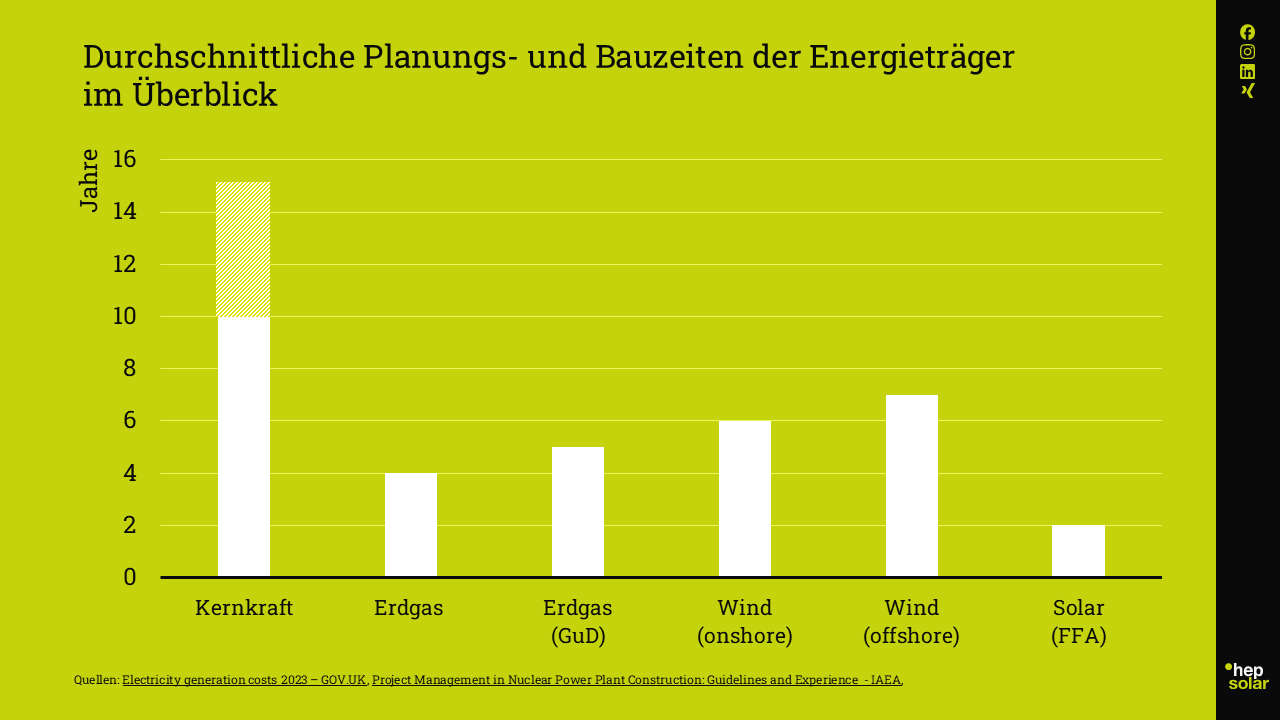
As a general rule, the more complex the underlying technology, the longer development, construction, and commissioning take. However, to better understand the differences, it is worth taking a look at how each energy source works, its benefits, and its future role.
Natural Gas: Gas Turbines and Combined Cycle Power Plants
Conventional gas turbines operate on a simple thermodynamic principle: air is highly compressed in the compressor, mixed with natural gas, and burned under high pressure in the combustion chamber. The resulting hot exhaust gases flow through the turbine blades, setting them in motion. Via a common shaft, the turbine drives a generator that produces electricity.
Combined cycle gas and steam power plants (CCGT) take this a step further. The exhaust gases from the gas turbine remain at a very high temperature even after passing through it. In a waste heat steam generator, this residual heat is used to heat water into steam. This steam drives an additional steam turbine—a second generator produces further electricity. This combination of gas and steam turbines allows the fuel to be used twice, and the overall efficiency rises to over 60 percent—significantly higher than in simple gas turbines.
In Germany, modern combined-cycle power plants are currently being actively promoted to gradually replace coal-fired power plants and close supply gaps in electricity generation from renewable sources. Simple gas turbines, on the other hand, are now built almost exclusively for reserve and emergency power purposes. Thanks to the largely standardized turbine and power plant technology, planning and construction times are relatively short: about four years for simple gas turbines and about five years for modern combined-cycle plants.
Onshore and Offshore Wind Farms
Wind turbines convert the kinetic energy of the wind directly into electricity. The wind turns the rotor blades, which transmit this motion to a generator via a shaft—similar to the principle of a bicycle dynamo.
Wind energy can be generated both on land (onshore) and at sea (offshore). Onshore expansion in Germany is being strongly promoted at the political level, but in practice it often faces limited land availability, acceptance issues, and lengthy permitting processes. Offshore turbines are considered particularly powerful and deliver higher full-load hours due to more consistent wind speeds. However, their implementation is significantly more complex: construction and installation require specialized vessels, seaworthy foundations, complex logistics, and narrow time windows with stable weather conditions. Storms and extreme weather can delay both construction and connection to the power grid.
These technical and organizational requirements are reflected in project timelines. For onshore wind farms, they average around six years. Offshore projects take about seven years due to the challenges of the open sea, with grid connection and civil engineering often representing the most critical phases.
Nuclear Power: Conventional Large Reactors
In nuclear power plants, energy is generated through the controlled fission of atomic nuclei. The heat released in this process heats water to produce steam, which drives a turbine. As with gas and wind power plants, this turbine is connected to a generator via a shaft. Thanks to their continuous operation, reactors provide very consistent amounts of electricity capable of meeting base load demand.
However, the construction of a new nuclear power plant is one of the most complex infrastructure projects worldwide. Extensive safety assessments, precise site analyses, international permitting processes, and long supply chains characterize project development. Many of the large components required are manufactured by only a few specialized producers. The high investment costs and long construction times mean that nuclear power plants generally do not become economically viable until decades later.
While no nuclear power plants have been in operation in Germany since April 2023, countries in Asia, the Middle East, and Eastern Europe are seeing moderate expansion. New reactor concepts such as small modular reactors (SMRs) are still predominantly in early stages of development. Consequently, typical project duration for conventional large reactors ranges from ten to fifteen years, and often exceeds that.
Solar Energy: Large-Scale Ground-Mounted Systems
Photovoltaic systems convert sunlight directly into electrical energy. To do this, they use solar cells that generate direct current through the photoelectric effect. This current is converted into alternating current by inverters and fed into the power grid.
Large ground-mounted systems are primarily built on agriculturally disadvantaged land and benefit from modular, industrially standardized technology. Modules, mounting structures, and inverters come from efficient supply chains, are available in large quantities, and can be installed in parallel across the project site. Therefore, organizational factors such as securing suitable land, conducting environmental assessments, and coordinating with the grid operator are crucial to the project’s pace.
Once these prerequisites are met, construction can be completed within a few months—and typical project timelines of around two years from planning to commissioning become feasible. This is a key reason why photovoltaics is now among the most dynamic and fastest-growing renewable energy sources worldwide.
Sources:
- https://www.gov.uk/government/publications/electricity-generation-costs-2023
- https://assets.publishing.service.gov.uk/media/6555cb6d046ed4000d8b99bb/annex-a-additional-estimates-and-key-assumptions.xlsx
https://www.dlr.de/de/next/energie/stromproduktion/die-heissesten-materialien - https://www.wpd.de/wind/deutschland/projektentwicklung/
- https://www.iaea.org/publications/15943/nuclear-power-reactors-in-the-world
- https://www.iaea.org/publications/8759/project-management-in-nuclear-power-plant-construction-guidelines-and-experience
- https://publica.fraunhofer.de/handle/publica/479064
- https://www.ise.fraunhofer.de/de/veroeffentlichungen/studien/aktuelle-fakten-zur-photovoltaik-in-deutschland.html