
The energy transition requires land—but competition between solar power, agriculture, and nature conservation is intensifying. An innovative solution to this challenge is “solar grazing”: the use of grazing animals, particularly sheep, for the ecological maintenance of solar farms.
Solar Grazing – When Sheep Tend to Solar Fields

What has already been tried and tested many times in the U.S. also shows great potential for Germany—ecologically, economically, and socially. hep solar is already using the animal-assisted grazing model in several projects in the U.S., thereby creating new sources of income for local farmers. But how does solar grazing differ from the agri-photovoltaics system familiar here in Germany? What ecological benefits does the method offer? And what potential does solar grazing have in Germany?
What is Solar Grazing?
Solar grazing is the use of animals—primarily sheep—to maintain open-field photovoltaic systems. Instead of relying on regular mowing to limit plant growth or on chemical herbicides for weed control, the animals take care of vegetation management: They graze around the solar modules, reach hard-to-access areas, and even promote soil aeration naturally through their movement. Research from Cornell University shows that solar grazing can reduce vegetation management costs by up to 40%—while simultaneously improving soil quality and water retention.
In addition to the environmental benefits, there are also economic advantages: this approach provides farms with an additional source of income from their sheep herds. Particularly well-suited are hardy, low-maintenance, and hornless sheep breeds such as Katahdin, Skudden, or Shropshire, which adapt well to the conditions in solar parks. While other grazing animals such as goats, poultry, or cattle are theoretically possible, they present certain challenges: Goats are prone to climbing, poultry requires reliable protection from predators, and cattle are better suited for agri-PV systems with modules mounted on high structures.
Distinction: Solar Grazing vs. Agri-PV
In Germany, the term “agri-photovoltaics” (agri-PV) is primarily associated with the combined use of agricultural land for crop cultivation or specialty crops beneath solar panels—for example, solar panels mounted on high structures above grain fields, orchards, or vineyards.
Solar grazing, on the other hand, is a specific form of agri-PV in which extensively used pastureland is grazed beneath existing ground-mounted PV systems. The major advantage is that this form of dual use is possible without any technical modifications to the solar modules or the mounting structure.
From a planning perspective, solar grazing is also particularly easy to implement: it requires no additional building height and no special spacing or clearance widths. Conventional installation techniques can be integrated quickly and easily, both in new projects and in the ongoing operation of existing ground-mounted PV systems.
Solar Grazing, but Sustainable
While traditional solar grazing is primarily aimed at reducing the costs of mowing, Sustainable Solar Grazing follows more advanced principles: For example, it employs rotational grazing, in which sheep are moved across the area in sections. This allows for regeneration periods for the grass and soil, prevents trampling damage, and reduces erosion. The microclimate benefits from the shade provided by the solar panels and the elimination of mechanical maintenance. After all, where no machinery is used, emissions are significantly lower.
Gentle access to the pasture also plays a role. Instead of permanent fences or heavy machinery, herding dogs can be used, which make livestock management more flexible and less stressful, while also saving costs.
The project is often carried out in cooperation with regional sheep farms. This strengthens local agricultural businesses and creates economically viable partnerships. Sustainable Solar Grazing thus encompasses more than just vegetation control. It is an integrated land-use concept that combines photovoltaics with the principles of sustainable land management and aims to strike a balance between electricity generation, soil conservation, animal welfare, and local agriculture.
Best Practice: Sustainable Solar Grazing in North Carolina
A successful real-world example comes from North Carolina (USA). There, farmer Alex Greer, owner of “37 Roots Farm,” now manages two solar farms operated by hep solar: RCCC in Salisbury and Perendale in Mocksville.
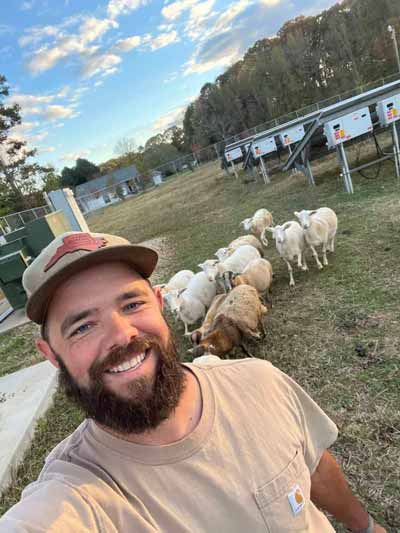
“Sustainable Solar Grazing wasn’t something I was actively looking for. It all started with a simple checkmark on a questionnaire. Today, it’s a central part of my farm’s future. Working with a dedicated and reliable partner like hep solar has been instrumental in turning this opportunity into a sustainable path forward.”
— Alex Greer, 37 Roots Farm